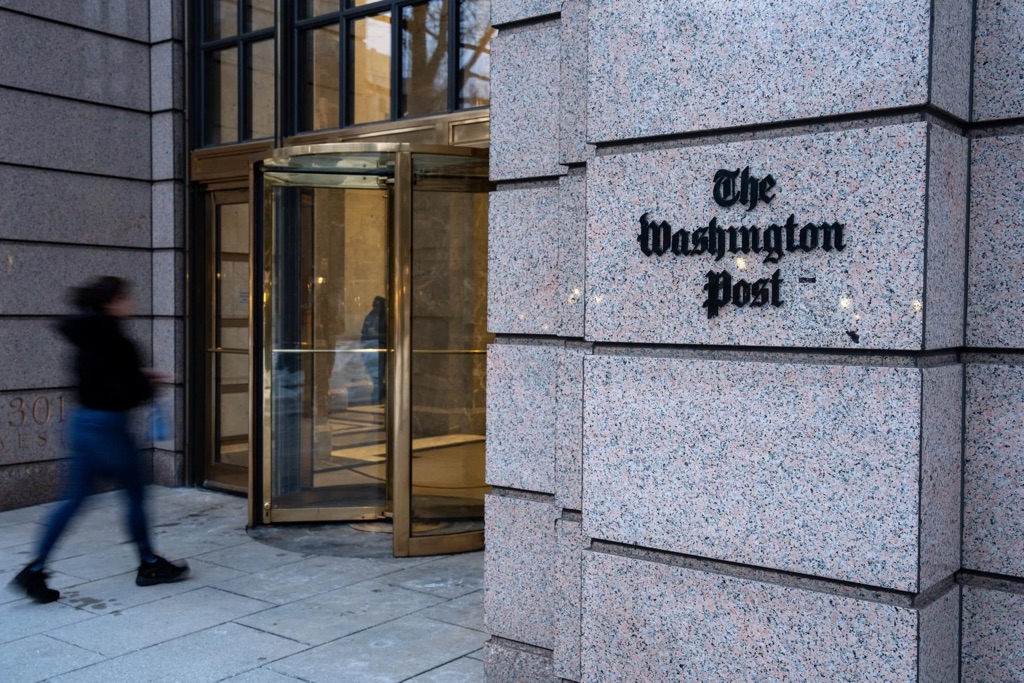
 | |
Requiem for the Washington Post
By Leon Hadar
The newspaper that brought down a president is dying in darkness—and its billionaire owner lit the match.
The recent announcement that the Washington Post will lay off one-third of its workforce, eliminating entire sections and gutting its newsroom, marks not just another round of media industry cuts but the final chapter in one of American journalism's most precipitous falls from grace. What Jeff Bezos is calling financial necessity is really an autopsy report for a suicide.
The Post's death spiral began not with market forces but with moral failure. In October 2024, just eleven days before a presidential election, Bezos killed the editorial board's planned endorsement of Kamala Harris. The decision wasn't about journalistic neutrality—it was about protecting Amazon and Blue Origin from a potentially vindictive Donald Trump presidency. Over 250,000 subscribers canceled within days, taking their subscriptions and their trust elsewhere.
Former executive editor Martin Baron didn't mince words: this was "disturbing spinelessness" and "self-inflicted brand destruction." Legendary Watergate reporters Bob Woodward and Carl Bernstein watched their life's work crumble as their paper's owner chose profits over principles. Editorial cartoonist Ann Telnaes resigned after the Post refused to publish her work criticizing billionaires cozying up to Trump. The message was clear: democracy dies in darkness, especially when a billionaire switches off the lights.
The bitter irony is that Bezos could fund the Post's losses indefinitely without noticing. His $249 billion fortune means the paper's $100 million annual loss is a rounding error—less than he spent on his wedding, a fraction of the cost of his half-billion-dollar yacht. These layoffs aren't about survival; they're about priorities.
In February 2025, Bezos announced the opinion section would publish only pieces supporting "personal liberties and free markets"—a euphemism for conservative orthodoxy that alienated the liberal readership the Post had cultivated for decades. This week, as journalists learned their positions were eliminated, Bezos hosted Defense Secretary Pete Hegseth at his Blue Origin facility, celebrating a $2 billion Space Force contract. The calculation is transparent and grotesque.
What distinguishes the Post's decline from other struggling newspapers is that its wounds are self-inflicted. While the New York Times approaches 15 million digital subscribers and the Wall Street Journal thrives, the Post hemorrhages readers and credibility. The problem isn't the business model—it's that Bezos systematically dismantled the institution's moral authority to curry favor with a president his own newsroom documented as a threat to democracy.
The journalists being laid off this week didn't create this crisis. They produced award-winning work exposing corruption and holding power accountable, only to watch their owner silence their editorial board, gut their opinion section, and sacrifice their jobs to protect his space contracts and his retail empire.
A free press requires independence from both government and the business interests of its owners. When billionaires buy newspapers as toys or tax write-offs, journalism becomes just another asset to be leveraged. The Washington Post proved democracy can indeed die in darkness—sometimes at the hands of those who claim to defend it.